|
|
Art View
|
|
|
|
 The Human Being Before Birth: Andreas Jaeggi as an Artist-in-Residence for the Museum of Natural History in Le Havre (France).
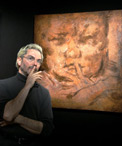
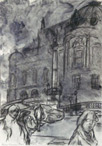
 I Don't See Anything Yet: Andreas Jaeggi gives a face to the unborn human being.
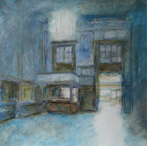
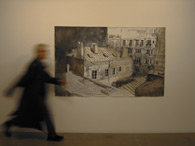
 A House in Paris: Andreas Jaeggi likes to provoke through unusual perspectives.
|
Swiss Illustrated Magazine The Best of Culture "Andreas Jaeggi, Jack of All Trades" Success Across the Borders: Andreas Jaeggi performs on stage at the Paris Opera as a soloist. The tenor from Basel makes a parallel career as a painter – in Switzerland and in France.
He is an artistic man, through and through, this Andreas Jaeggi from Basel. "Singing, painting and drawing are like breathing, eating and drinking to me," he points out. "And, especially as a visual artist, I need to be able to hold my breath for a very long time in order to survive." Unlike in his singing.
As a tenor, he will be on the stage of the National Opera of Paris / Bastille in three productions this upcoming season. And this in three different languages: in Richard Strauss' "Salome" he'll sing in German, in Massenet's "Werther" in French and in Britten's "Billy Budd" in English. "These are exciting projects," Jaeggi exclaims happily. Singing is like a top competiton sports discipline for him, daily vocal training therefore mandatory. "For my mental balance, my artwork is also extremely important to me," emphasizes the fully-fledged art designer.
Due to his regular work abroad, feelings of restlesness, abandonment, loneliness and homelessness are awoken within the singer. Through his painting, he creates a new home in foreign territory. Painting ustensils are therefore always in his luggage. First there are the music scores, then brushes and paint tubes, and in the end, there is only room for just a couple of T-shirts. "I paint everywhere and every day, even on the kitchen table," he recounts. And he laughs. "Because I can not wait until I am back home in Basel to paint."
Now, the Museum for Natural History in Le Havre (France) has invited him there to be a guest artist. As an Artist-In-Residence, he created a series of works for the exhibition "Before Birth, 5000 Years of Images". The show, curated by Alain Germain, includes amongst many other objects an Acient Egyptian mummified foetus in a painted sarcophagus and life-sized wax models from the 19th Century.
All the museum rooms have been painted black in order to give each individual exhibited object a strong presence, including the spaces showing Jaeggi's works. He made seventeen paintings and four drawings within fourteen days. "The most difficult part was the mental preparation and studying pre-natal pictures." The works of art are inspired by three-dimensional high-tech echographies, furnished by the specialist Jean-Marc Levaillant.
The big canvases come across as sketchy and gestual. The painter has given an identity to these anonymous beings. Definitely not child's play. "The representation of an unborn is extremely demanding. Very easily it can look either like a monster or too cute."
Le Havre – Paris – Basel: Andreas Jaeggi's calendar is full. His American life partner of many years, Ron Rubey, takes care of shuffling his contracts and handling the finances and office work. "Without him, I could not accomplish all of this. Ron lifts these tasks from my back so I am free to create."
The artist and the former professional dancer live in a lavish Art Nouveau apartment near the Basel Zoo. "I can only enjoy my gypsy-style life because we have this beautiful home base," admits Jaeggi. Whenever time permits, he retires to his studio in the basement in the evening. He extracts the pictures out of his head and places them onto canvas. Swiftly and with ease.
This lightness is also reflected in his motives. A house, caught through the window of an airplane or seen from the depth of an urban canyon. The spiraling staircase of the Guggenheim Museum in New York. The "Mona Lisa" in the Louvre. Works which provoke through their unusual perspective a different way of seeing.
If you cannot make it to Le Havre to see Andreas Jaeggi's latest artwork, you might also encounter it in Basel at the moment. "Beautiful Views" is a show of around 100 paintings and sculptures from the artist at the Trafina Private Bank. The exhibition demonstrates his artistic diversity and brings to light his unbelievable creative urge.
By Isolde Schaffter-Wieland
"To paint an embryo is not child's play." Andreas Jaeggi, Artist
|
|
|


|
"Power Voice with Artistic Talent"
The singer Andreas Jaeggi also likes to sketch a cool pop art still life every so often.
Andreas Jaeggi from Basel (Switzerland) exercises two professions at the same time: he is a classical opera and concert singer and a visual artist. This is only made possible thanks to the relentless support of his life partner Ron Rubey.
Multiple talents who are simultaneously opera singers and painters as well as sculptural object artists cannot be found on every street corner. At the address Tiergartenrain 5, we do meet Andreas Jaeggi who is one of these multifaceted talents to whom art and life are an inseparable unity.
One can feel this when visiting his elegant Art Deco apartment: not only will you find selected pieces of furniture and a piano with musical scores but, above all, you will discover many paintings and sculptures which the artist has created over several decades. After giving us a sample of his vocal power, we become totally immersed in the fascinating world of music and art.
His love for art has been put into the cradle, so to speak, when Andreas Jaeggi was born in 1952. His mother was an artist (painter), his father was a publisher and later became the owner of the distinguished Jaeggi bookstores in Basel and Bern (Switzerland). Flute lessons and studies at the Basel Art & Design School during the 1970s laid the basic foundation of solid craftmanship upon which Jaeggi's enormous creativity has been built. Already as a 22 year old, he began to design costumes and stage sets for the Parisian music theatre company "Compagnie Alain Germain".
Classical Opera and Concerts
Andreas Jaeggi says he came towards singing through sheer coincidence. An apartment neighbour remarked once that he could draw very well but that he could sing even better. Encouraged by this, Jaeggi enrolled at the music conservatory where he was immediately welcomed and soon enough, he was asked to sing his first Bach cantata as a tenor. He then studied for several years with the world renowned classical opera singer Maria Stader perfecting his vocal skills and for three decades now, he continues to excell as a soloist and character performer in the field of opera and classical concerts.
His powerful voice and his acting abilities quickly brought him yearly contracts in various German opera houses. At the Osnabrueck Opera House, 25 years ago, he met the American dancer Ron Rubey who became his life partner. Thanks only to this harmonic partnership and collaboration, Jaeggi insists with emphasis, is it possible for him to live out his inclination towards and love of singing and the visual arts to the fullest.
In the musical field, Jaeggi recently signed two new contracts with the National Opera of Paris (France) for the future opera productions of "Salome" by Richard Strauss and "Billy Budd" by Benjamin Britten (*). Before then, he will be heard and seen as Doktor Blind in Johann Strauss' operetta "Die Fledermaus" at the Amsterdam Opera House during the 2008/09 season.
(* Andreas Jaeggi's next production at the Bastille will take place in 2009 when he will be portraying Goro in "Madama Butterfly" by Puccini with staging by Robert Wilson.)
Art and Visual Work
Despite all his success as a singer, Andreas Jaeggi admits very openly that the visual arts are actually the center of his life. In drawing, painting and sculpting, he presumably finds the space and freedom which allows him to fully live out his creative urges. The artist knows how to express his experiences and feelings in many different ways: in pop art still lifes, impressionistic urban landscapes or in surrealistically inspired figures made of clay and two-component resin.
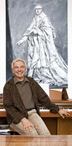
One of Jaeggi's particularities are the slightly ironical estranged versions of works by the old masters. For instance, he completely and unabashedly copies a portrait of Richelieu by Philippe de Champaigne from the 17th century and replaces the cardinal's head with his own head and face. Similarly, he has created a series of drawings where – instead of Leonardo's Mona Lisa – he inserts such famous heads as Einstein, Mother Teresa and even Donald Duck. Through this procedure he succeeds without any doubt in enhancing the symbolic power of these figures in a very personal way.
In the year 2001, Andreas Jaeggi and Ron Rubey started to organise exhibitions in Switzerland and abroad in order to present the works to a broader audience. "Through these exhibitions we were able to collect valuable experiences. By the end of 2007, we decided to interrupt all exhibition activities for the time being," says Jaeggi. This undoubtedly to reflect on the past and to find time to create new works that art lovers can look forward to discovering with curiosity and anticipation in the future.
By Renate Duerst for Basler Zeitung
Top Photo: "Exchange. Andreas Jaeggi in front of his portrait of Richelieu in which he has replaced the cardinal's head with his own likeness." Photos by Lea Hepp (photos not free of copyright)
|
|
|


|
"Mona Mania"
In the canon of Renaissance art, perhaps no image is more recognizable than Leonardo da Vinci's portrait of the wife of a wealthy Florentine silk merchant. Search Google for Mona Lisa and upwards of 4.6 million references appear. Now an icon and starting point for additional artistic expression, the enigmatic image is reproduced, parodied, caricatured, and manipulated in thousands of ways by people all over the world.
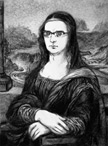
For Andreas Jaeggi, artist/sculptor and opera/concert singer located in Basel, Switzerland, the Mona Lisa became "a most recognizable visual witness of past European culture." Using this famous source as a base, he has completed 21 drawings in what will be an on-going series exploring celebrity and its representations. Replacing Leonardo's original mysterious woman with 20th century figures known world-wide, Jaeggi plays with perspective in various forms.
He pushes, prods, teases, and asks us to pay attention not only to the primary subject but to every part of every picture. Interpretation of landscape details – some subtle, some obvious – are significant, particularly Leonardo's use of two different vanishing-point perspectives. The background landscape on the left side of the picture is completely different from that on the right. Jaeggi and others, including Nicolas Pioche of WebMuseum Paris, recognize this device as Leonardo's way of creating two "fantasy" landscapes that are not actually connected.
A sense of humor is also a useful accompaniment when viewing Andreas Jaeggi's The Mona Project. The artist's own Mona portrait (Mona Myself) could almost be mistaken for the original – albeit in black-and-white – until the myopic gaze behind a diffusion of eyeglasses sneaks into view. The series' other subjects may be more famous, but the iconic quality of the image remains, even with the literal and figurative comic representations of the selected models. After all, Donald Duck came to life in Walt Disney cartoons. And while the story of Snow White has been in our mythology for generations, the image that most contemporary people associate with this character is the one from Disney's 1938 animated film.
The choice of celebrity and the selection of that celebrity's most recognizable representation are only two of the questions Jaeggi poses to himself in the development of original drawings for The Mona Project. The artist also considers: "Is there a moment in the life of these celebrities when time stops, their image crystallizes, and that's how they are always remembered? At what age should the celebrity be depicted? Is a particular pose important?" And he concludes: "Often, only a very specific image of a celebrity is known to all of us and is truly representative of that person." Like the esteemed lady herself, those images become the icon, and they are the ones Jaeggi chooses for The Mona Project.
The current series began with black-and-white pencil drawings. Color pencil has been used for some of the more recent images, but the artist seems a bit ambivalent about its value. "Color doesn't always add depth and more meaning to a work," says Jaeggi. "The more stylized and restricted choice of expression has often turned out to be the more poignant. Of course, each work will be seen through the eyes of individuals with their own experiences and recollections or connections to the subject."
While a work like Mona Teresa may evoke a meditative or philosophical response because of its impressive facial expression, the wink and nod of humor is apparent in other pieces, particularly Mona Warhol. In addition to its combination of black-and-white and color in the head and shoulders, Jaeggi's very Warholian pop-culture reference is a paint-by-numbers landscape and wardrobe.
Jaeggi feels humor is based on "making fun of someone specific or a specific group of people in a specific situation, both geographically and in time. Primarily, it means not taking things too seriously but with a certain personal distance and perspective." Of course, such an attitude presupposes a level of maturity, which may not be present in either the subject or viewer. One person might enjoy the humor while the next may take offense. But, says Jaeggi, "even the most hilarious rendition of a public figure can be a respectful and deeply felt homage."
Leonardo's Mona Lisa has been on both sides of this street: revered and caricatured, celebrated by art historians and deconstructed by popular culture. The original oil painting on poplar wood (77 x 53 cm) is housed in the Louvre Museum in Paris. Begun in Florence, Italy, in 1503, the portrait is said to have taken three or four years to finish. When Leonardo moved from Italy to France some ten years following its completion, he took the painting with him, where he reportedly sold it to the King, Francois I.
And while Mona Lisa has called the Musee du Louvre in Paris home for the greater part of her life, she is also much traveled. The painting resided at Fontainbleau and Versailles, before settling down at the Louvre after the French Revolution. Even Napoleon was fascinated by the image, installing it in his bedroom at the Tuileries.
But it took until the mid-1800s for the Mona Lisa to find fame in artistic circles, and, eventually around the world. Not all the notoriety was good. In 1911, at the behest of a con man, a Louvre employee stole the painting, and it remained missing for two years. During World War II, the Mona Lisa was stored away from Paris, returning to the Louvre after the Armistice. Following several incidents of vandalism in the late 1950s, the painting was installed behind security glass. Short tours to the United States in the early 1960s and to Tokyo and Moscow in 1974 have since been its only outings. In 2005, the painting was moved to a specially protected hall within the Louvre.
So how did this icon of Renaissance enlightenment become the target of pop culture parody and avant garde art? Many credit Marcel Duchamp, the influential Dadaist, with the first caricature. His 1919 "L.H.O.O.Q." is a cheap postcard-size reproduction sporting a scribbled-on moustache and goatee. The title is actually a crude comment and double entendre: when spoken aloud in French, the letters sound like "Elle a chaud au cul," which translates to "She has a hot ass."
Over the years, Mona Lisa – or her mysterious history – became the subject of songs, stories, books, movies, and all manner of art. Dan Brown's novel "The Da Vinci Code" and the movie of the book released in 2006 are only the most recent examples of how this famous painting has permeated Western culture.
In The Mona Project, Andreas Jaeggi follows both da Vinci and Duchamp, creating portraits enigmatic and outrageous, subtle and challenging. By choosing one of the most recognized paintings on the planet and pairing it with some of the most recognized celebrities of our day, Jaeggi asks us to get involved with the world and its representations. Whether viewers groan or grimace, smile or laugh, Andreas Jaeggi's The Mona Project engages mind and heart – and leaves us all the better for the experience.
By Jill J. Jensen
"The Mona Project" Art Catalog and Exhibition Event, Basel (Switzerland)
|
|
|
|
"Views and Glances – with Brush Strokes, through the Photographic Lense and with Passion"
Andreas Jaeggi's paintings of objects and urban views are a confrontation and, at the same time, a thematical approach to the exhibited photographic works of the other three artists. The cityscapes, painted on canvas or canvas panels, are urban impressions as they are experienced by the opera & concert singer, stage costume & set designer and artist while living in Basel as well as during his many stays in numerous world capitals such as Paris and New York. Painted in the fashion of Neo-Pop-Art, his paintings often appear to be impressionistic, they show tendencies towards monochromy, they interprete earlier painting styles in an ironic way, they express and reflect personal experiences and memories, illuminated by colored theatrical lighting. Andreas Jaeggi's oeuvre is the work of a painter and of a graphic designer at the same time, they pretend to be in water colors and ink or based on photography, they seem to be spontaneous or planned, they mutate into familiar places of a citizen of the world to whom art is a way of life.
By Kiki Seiler-Michalitsi (Curator)
|
|
|
The Eye and the Camera The perfectly staged show shows works by Peter Hermann, Werner Grieder, Hansbeat Stricker and Andreas Jaeggi. The camera is an instrument of unsuspected pictorial possibilities: in a thrilling way, three photo artists witness this, to which the thematically related paintings by Andreas Jaeggi are opposed ... Within the city impressions from Basel, Paris or New York, he swings with great virtuosity from photorealistic precision to sketch-like spontaneity, and thereby creates a fascinating mixture between a landscape of the soul and a precise rendition of a real place.
By Renate Duerst for Basler Zeitung
|
|
|
As far as the technique is concerned, the paintings by Andreas Jaeggi – in oil on canvas or canvas panel – are breaking ranks with the three photographers. And yet, they do form a harmonic entity with the photographs within the exhibition, curated by Kiki Seiler-Michalitsi. Andreas Jaeggi regularly travels abroad, not only as an artist with extensive exhibition activities but also as an opera singer, costume designer and set designer. His city impressions of New York, Paris and Basel stun on one hand by the almost photographic precision, on the other hand by a highly individual artistic translation which includes impressionistic elements as well as techniques used in Pop Art.
By Sibylle Meyrat for Riehener Zeitung
|
|
|
The current exhibition at the Kunst Raum Riehen, curated by Kiki Seiler-Michalitsi, is called "Views and Glances – with Brush Strokes, through the Photographic Lens and with Passion". The title doesn't promise too much: in the space, located near the Beyeler Foundation, the works of four artists are to be seen, photographs and paintings which show familiar, but also unusual sights and views, insights, outlooks and glances; they show people having fun or in a thoughtful mood, individual portraits and groups, architectural curiosities, contrasts and reflections, landscapes – mostly in black and white, partially in color.
One is touched by a breeze of the great big and generously wide world through the paintings by Andreas Jaeggi and the photographs by Werner Grieder, Peter Hermann and Hansbeat Stricker. The artists which represent different times and styles, do not form a group. Though in their themes and subjects we may find parallels as well as oppositions, together they share a view of the visible world which recognizes the signs of their time.
The painted pictures and objects by Andreas Jaeggi are a confrontation and – at the same time – a thematical approach towards the photographic works. After completing his Graphic Design studies at the Basel Art School, Jaeggi finished additional studies at the International Opera Studio at the Zurich Opera House in 1976 and began his unusual career as a costume and set designer, as well as a performer, opera and concert singer. The exhibition at the Kunst Raum Riehen shows only a very small fraction of his multifarious work which documents the common trait of all the art work shown here: the joint, but highly individual view of the visible world.
By Annina Fischer for Basellandschaftliche Zeitung
Exhibition: "Views and Glances – with Brush Strokes, through the Photographic Lense and with Passion" Gallery Kunst Raum Riehen, Basel (Switzerland)
|
|
|


|
"Peaceful Heads"
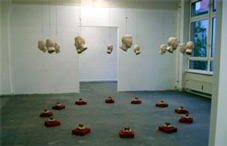
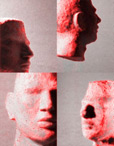
A floating graveyard. Twelve white heads, hanging in a circle at eye level to the onlooker. Twelve identical reproductions of a young man's head. Laying on the floor directly below each head, two red bricks, on these a round loaf of crusty bread with a rolled and knotted cotton gauze bandage. Parallel to this, twelve sheets of paper, on which Jaeggi has captured the various thoughts that have led him to the execution of his project "Peaceful Heads".
This new installation by Jaeggi was seen for the very first time at Berliner Kunstprojekt in June 2003. After much noticed exhibitions in New York and Paris among other places, where his extensive painting work has been shown, in Berlin a new facet of the painter, opera singer and sculptor Jaeggi is brought to light in the shape of a sculptural installation of extremely complex contents.
First, it surprises one that this very harmonically arranged group of figures which allows the onlooker generous room for interpretation is accompanied by the explanatory additions of these drawings. Does the artist not trust the impact of his work? Does a glance at the working process, a glimpse behind the scenes not take away the mysterious effect of the floating sculptures? On the sheets, one finds photographs, drawings in charcoal and pencil as well as excerpts from texts. If one is looking at the contents of these sheets of paper, one has to answer in the affirmative as well as to deny the above questions at the same time.
One has to answer in the positive because Jaeggi dissociates himself somewhat from the sacred aura of the installation through his humorous additional notes. As an example, a scrap of paper is found with the inscription: "For Tuesday, June 3, 2003 order from the Bumann Bakery 12 flat Valaisan breads of 7 x 7 inches." On a different sheet, next to a head study drawn over a scale grid, the added remark: "Yes, yes, I use scale grids just as Vermeer and Duerer did." To allow the onlooker such profane glances at the creation of an art work makes the artist sympathetic, it brings him closer to his audience.
One has to answer the questions in the negative if Jaeggi's drawings take away from the onlookers freedom of her/his own associations, because they show the very large scale of Jaeggi's own approach to the theme which in the end initiates a thought provoking process rather than a set formula of interpretation. Pictures from the TV station BBC World showing marching soldiers, the mummified head of Ramses II, head studies drawn by the artist's mother Pia Jaeggi-Candrian and a small picture of her grave are just some samples.
Jaeggi says he is interested in the transformation of body types following the course of historical periods. In connecting the rolled-up gauze strips on the bricks (= tomb stones), which could come from the grave site of a minor Egyptian dignitary, with the representations of a young man's head of today's proportions, Jaeggi draws an iconographic circle. The twelve variations of the same model allow an intended confrontation of cloned beings and permit therefore a glimpse into a not so distant future.
For me, the installation in its regular formation radiates the calmness and harmony of a cultic grave site. The floating heads seem like ghosts of the deceased. I see in them 12 entire bodies, their feet being the red bricks still anchored solidly into the ground, the body reduced to a loaf of bread, the dirtied gauze rolls a symbol for the injuries collected during a life time and, of course, the head which has been seperated from the ballast of all things earthly.
The strength of this work lies ultimately exactly there: to take the onlooker first by her/his hand and let her/him take part in the thought process and the manual execution of the art work, without however making any final statements, which allows one in the end to approach the work with one's own associations, on eye level with the artist and his "peaceful heads".
By Ralf Katzenstein for NY Arts Magazine / Berliner Kunst
Exhibition: "Peaceful Heads" Spatial Installation Gallery Berliner Kunstprojekt, Berlin (Germany) & Agora Gallery SoHo / Chelsea, New York City
|
|

|
|
|


|
"Peaceful Heads" and "The Salome Excavation"
Andreas Jaeggi's work explores the concept of art as the product of history and past events, the offspring of its precursors. He contends that only after it has been dissected and digested by art critics, reproduced and distorted by photographers, and forcibly driven into our conciousness do we appreciate a work of art. Even then, he says, these mere vestiges of a truly original artwork are elevated to such a place of distant veneration that a visceral, impulsive and sincere response to the piece is precluded. Thus Jaeggi cultivates this artistic obsession with the archaic and the revisited, plunging into and surpassing the entrenched conceptions of art as a consequence of protracted historical and critical processes. And yet, he does so not without an element of humor, a hint of deception, and, ultimately, the subversion of the conventional (and tedious) approach to appreciating art. The pieces in his exhibition, "The Salome Excavation" are "to be perceived in a way of a completely phoney monumental historic movie of B-class: a choice selection of fake antiques ..."
"The Salome Excavation", a sculptural project in collaboration with Ron Rubey, features twenty-two pieces inspired by the biblical chronicle of Salome, the daughter of Herodias and stepdaughter of King Herod Antipas. In this New Testament account from the gospels of Matthew and Mark, King Herod agrees to give Salome anything she desires if she will dance before him. Salome requests and is granted the head of John the Baptist, presented to her on a platter. The story of Salome has been a popular subject of Christian art throughout the ages, in representations by famous artists, and in various operatic and text versions by renowned writers. An internationally recognized classical opera and concert singer as well as an artist, it is no wonder that Jaeggi chose to recreate a story so powerful in the world of opera.
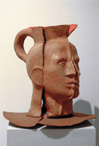
"The Salome Excavation" includes various figurative sculptures such as "Salome's Gold Mask", "Salome's Make Up Palette" and "Petite Salome", which describe the face or head of a young woman who so infamously caused the beheading of a revered saint. Other figurative works depict a four-headed King Herod, a startling scarlet head of Jokanaan (Oscar Wilde's version of John the Baptist) and the sanguine figure of Narraboth, a young captain of the guard who kills himself after his love for Salome is rebuffed. Each work is a subtle intergration of ancient art forms and contemporary processes and sensibilities. Through this collection of invented artifacts, sculpted from acrylic modeling paste, clay, papier-mache, metal, egg tempera, acrylic, color pigments and various other materials, Jaeggi reconstructs the strange and dramatic narrative that has intrigued, entertained and haunted audiences for centuries. Jaeggi describes his most recent installation "Peaceful Heads" as a "floating graveyard of severed heads hanging from the ceiling at eye level", a prospect of "great calmness". These suspended visages are not representations of the realitites of the act of death and the suffering surrounding it, but rather an expectation of death as a state of great serenity, even a liberation from the miseries of the living world. Sculpted from clay and enhanced with oil and acrylic paint, these portraits of death are also visions of youth and tranquility. Between the blanched, hovering heads and the earthen, pondereous forms of their tombs exist a vacant space of great potency, a void composed of the absence of body, perhaps, or the presence of ethereal spirit.
In reinventing ancient themes and incorporating elements of classical sculpture into his work, Jaeggi explores the concept of originality, reproduction and the lifespan of a work of art. While striving to depict an archetypal human being as in the tradition of ancient Greeks, Jaeggi also captures the contemporary aesthetic of the human body. Jaeggi was born in Basel, Switzerland, where he studied art for many years before going on to exhibit his work in group and solo shows throughout Europe and in the U.S. He has been invited to perform in numerous international opera houses and has been a permanent member of the Paris-based musical theater ensemble Company Alain Germain as a performer, and as a costume and set designer.
ArtisSpectrum Magazine
Exhibitions: "Peaceful Heads" and "The Salome Excavation" Agora Gallery SoHo / Chelsea, New York City
|
|
|


|
"Spatial Transcendence"
From elegant nudes to street scenes and interiors, Andreas Jaeggi's art is based on classical techniques and forms of expression, while suffused with a sense of individual vitality and true cultural energy. Jaeggi displays a solid knowledge of anatomy but evades static representation of the figure – with a gestural drawing style and expressive use of medium, his figures, cityscapes and still lifes possess a great sense of movement, agility and dynamism. Jaeggi's subject matter is chosen from images which leave personal impressions upon his memory from the world surrounding him: "Only things of my closest environment and things I have experienced myself interest me in my art work, elements which I can judge with the precision of scientific clearness." Jaeggi was born in Basel, Switzerland where he studied art for many years before going on to exhibit his work in six European countries as well as the U.S. Besides being an accomplished painter, Jaeggi is an internationally recognized classical opera and concert singer.
ArtisSpectrum Magazine
Exhibition: "Spatial Transcendence" Agora Gallery SoHo / Chelsea, New York City
|
|
|


|
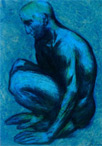
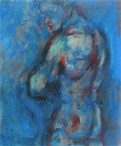
"Blue Period"
Exactly one hundred years after Picasso, a painter comes along and entitles his exhibition with a wink "Periode bleue", instead of calling it simply "Blue Paintings" or "Paintings In Blue". Obviously, it is important to Andreas Jaeggi to call this newest working phase a "period", the expression meaning a limitation in time. It's quite possible that in 40 years' time some one will write similar phrases about Andreas Jaeggi as Gertrude Stein did in 1938 when she commented on Picasso: "During this period between 1901 and 1904, he painted the blue pictures. Harshness and reality made him create these paintings on which everything he produced later was based."
The idea of painting mainly in blue came almost by itself to Andreas Jaeggi: one of his city impressions – a street scene from Dublin, Ireland – done not unlike another painting which can be seen in this exhibition ("The Atlantis Bar in Basel"), became totally blue through the artist's search for simplification. This particular painting fascinated Andreas Jaeggi so much that he decided to develop this color as a project, exploring its various shadings and themes.
It is a particular thing, the color blue. During the times of the Egyptian pharaohes, it was the color of the gods. In the "evening land", the European west, it only started to be used from the 12th century on when it was finally possible to produce ultramarine blue from the semi-precious stone lapislazuli. The resistance from the church against this color only eased up when in religious painting the rule was firmly established that Mother Mary's coat should always be represented in blue, the most expensive ultramarine there was. Only after 1600 did blue become one of the primary colors. Later on, it's general use slowly increased and consequently became more and more popular. The flag of today's European Community shows blue as the ground color and most adults nowadays name blue as their favorite color.
In his book "About The Spiritual In Art", Wassily Kandinsky pointed out in 1920 the special effect of colored light on the entire body. He noted "that color bears an enormous strength in itself. Hardly any research has been done concerning this matter. This force is able to influence the entire human body as a physical organism. Generally speaking, color is therefore a means to influence the soul directly. Color is the key(board). The eye is the (piano)hammer. The soul is the piano with many strings. The artist is the hand which makes the human soul vibrate by purposefully activating one key or another."
Let's get back to Andreas Jaeggi. The exclusive use of blue in his newest paintings leads towards a particular effect because, normally, each color changes its value through the neighbourhood of one or more other colors. A blue splash in the middle of a red surface has a different appearance and value than the same blue in yellow surroundings.
For Jaeggi, blue gains incredible depth and yet, it moves towards the onlooker after longer observation. The objects and the bodies become three dimensional. They seem full of mystery. They shine from inside. What Jaeggi presents to us are neither night pictures nor romantic scenes because they offer too much resistance. It takes a certain time and effort until one can really "see" the original work and experience its effect or – as Kandinsky would have said: "until the soul begins to vibrate".
Views of street scenes and houses – such as the "Atlantis"-painting – radiate a great calmness due to the one color reduction. They are painted with density and solid composition, even if the chosen angle is often dynamic. The brush strokes are loosly applied and full of life. The contours have a mysterious swing. The effect of these paintings can be explained by this opposition of quietness and dynamics.
Andreas Jaeggi's nudes reflect the artist's interest in representing the unclothed body. He shows us the surface but searches to catch the charisma and to carefully depict their eroticism. In some paintings, the bodies of two lovers seem to be transparent, the couples penetrating each other and the two forms therefore become one harmonious entity.
Remarkable and new are the still lifes by Andreas Jaeggi. The subject of the still life, the representation of lifeless, unmoving and dead objects, started to appear in western European painting in the 16th century. At first, still lifes were probably part of a bigger scenic image and then slowly became an independent genre. What the artists aimed at in the beginning was copying nature with a deceiving realism and the pure joy of fully representing any given object. Later on, other aspects took over: the artists took possession of motifs, colors and shapes. They personalized the relationship between object and background. The simplest object can become the reason for an artistic analysis.
As far as Jaeggi's still lifes are concerned, the same observations may be applied as to his city impressions: there isn't one line which doesn't swing. There isn't one contour which is regularly drawn. Everything vibrates. What also enhances the dynamics is the seemingly casually chosen angle and section of the depicted view. The objects are unspectacular. They are taken from every day life and they are not arranged. But one can feel the artist's connection with these items: they mediate a certain feeling of safety / security. On the other hand, they can also be taken and actively used.
In order to judge Andreas Jaeggi's present artistic freedom and strength of expression, one has to be familiar with the artist's earlier work. These were almost photorealistic renditions. They were pictures executed with great precision and stupendous artistry. In the expressive and nervous way of painting his city impressions, Andreas Jaeggi has moved away from his earlier work, even if the knowledge of precise drawing still is and always was the base of his artistic freedom. His latest work has become even more free. The reduction to one single color as well as a further dissolving of the drawing leads towards harmonious pictures that seem to be caught almost mysteriously in a strange balance between calmness and dynamics.
By Steffan Biffiger for NY Arts Magazine / Berliner Kunst
|
|
|


|
"Andreas Jaeggi’s Cityscapes and Figures Evoke a Shadowy World"
Certain artists develop techniques for evoking atmospheres in their work that become instantly recognizable stylistic signatures. One such artist is the frequently exhibited painter Andreas Jaeggi, also an opera singer, who was born in Basel, Switzerland, and is now known for his street scenes, many of New York City. Inhabitants of the city will recognize familiar places, albeit transformed by the artist's distinctive vision, in Jaeggi's recent exhibition at the Chelsea location of Agora Gallery.
In both the series that he calls "New York Zippers", painted in oils on canvas flags with side zippers and top eyelets, as well as the figure paintings that he refers to (with a bow to Picasso) as his "Blue Period", Jaeggi employs a palette of deep, saturated hues to imbue his compositions with darkly evocative dark atmospheres. One of the paintings in the former series, "New York Zippers: Thomas' Temple (Egypt in the Metropolitan Museum)", depicts the museum gallery where the ancient tombs are displayed, evoking the eerie sense of timelessness that one experiences there.
This is an especially powerful painting for its use of the interior space which projects a specific sense of place, while also functioning as a striking geometric abstraction. Jaeggi's use of somber brown and blue hues also enhances both the mood of the picture and its austere formal beauty.
Another painting in the series captures the Brooklyn Bridge in shadowy blue monochromes, enlivened here and there with sweeping strokes of white that evoke the atmosphere of a rain storm. The bridge, the harbor and the building, huddled at the shore-line, have a shadowy, almost ghostly quality, lending the composition an unusual poetic power.
Even the towers and billboards of Times Square are transformed by Jaeggi's subtle tonal magic in yet another oil. While most artists allow themselves to be seduced by the blazing neons of that fabled street, Jaeggi opts for a more characteristically lyrical quality. He presents Times Square in one of its quieter moments perhaps as seen in the first light of morning after a long night of revelry, when the signs are momentarily dimmed, and an introspective hush settles in, before "The Deuce" once again resumes its hectic hustle and bustle.
Yet another work in the series, "Treasure Island, Manhattan", is a bird's eye view of the island, predominantly in rusty brown hues that suffuse it with a sense of some ancient topography. This is one of Jaeggi's most abstract compositions, yet it is every bit as evocative as his other cityscapes in its own fashion for its somber, burnished tonalities and gracefully delineated forms.
The figures in Jaeggi's "Blue Period" series are evocative in another manner. Each painting depicts a single nude in predominantly blue hues, accented here and there with touches of the reddish brown color that the artist also favors. White highlights and, less frequently, bits of green help to flesh out these beautifully realized figures into palpable physical presences, which one encounters as though in the half-light of a dim bedroom.
By Maurice Taplinger for Gallery&Studio Magazine
Exhibition: "Spatial Transcendence" Agora Gallery SoHo / Chelsea, New York City
|
|
|


|
"A Search For Truth And Meaning"
Andreas Jaeggi is constantly searching for beauty, harmony and balance in his art-making. But more importantly, one might add, he is searching for truth. What would be the content suggested by these generalizations – often misused and abused terms – is always a challenge for any artist to articulate much less address in their work. All the same, through Andreas Jaeggi's exhibition of work at the Berliner Kunstprojekt he takes on the task of creating a true art of exacting beauty, harmony and balance while attempting to attain his goal of presenting work which creates a feeling of "great calmness".
The way to ellicit "calmness" is not obvious. The artist's description of the exhibition, taking place during the month of June 2003, belies, it seems, the sentiment of "great calmness" expressed above. Jaeggi describes the work as "a floating graveyard of severed heads hanging from the ceiling at eye level". Will the severed heads create calm? The viewers will be the judges.
The head sculptures have evolved out of many series of figurative works created by the artist. This project on display in Berlin has developed from an earlier series of sculptural works of twenty heads as well as from a series of portraits of individuals. Though working in the long tradition of figurative sculpture, Jaeggi uses the head of a young contemporary male as his model and does not step back into the canon of art history to find a source.
All the heads in the installation are made from one mold. The repetition of the single unidentified male's head brings the work into the realm of modernist art production. Air-dryed modeling clay is enhanced with oil and acrylic paint as well as color pigment. The modernist technique of repetition is not the only cultural reference that comes to mind. Given the physicality of the disembodied heads, which remains the same from head to head to head, the genres of horror and science fiction begin to come to mind. Cloning comes to mind as easily as Marcel Duchamp's recreations of his ready-mades. Andy Warhol meets "Invasion of the Body Snatchers" meets Goya's the "Horrors of War".
In this exhibition, Jaeggi is concerned with different issues than those confronted in his series "City Impressions" or "New York Zippers". "City Impressions" for one, not only takes the form of paintings but these paintings offer gently expressionistic and stylized representations of urban landscapes. Pain and the dark side of the human condition could perhaps be devined in these works through careful study but they are certainly not readily apparent on the surface. In this recent installation, Jaeggi is concerned with the realities faced by people with grave illnesses, severe disfiguring injuries and other physical or mental disabilities. His topic extends to other groups of people marginalized by their physical condition such as the aged. Also included in the discussion are the professionals whose task it is to care for the aged and the infirm.
These works are about much more than horror. As the artist states, the heads in this exhibition are "not what would remain in the basket of the guillotine during the French Revolution". He emphasizes that in modeling the sculptures he has "kept the forceful fleshiness of a young man's head". The artist's intention is for the public to see the possibility of life in death, of strength amidst the gathering of weakness and the overall diminishing of force. Despite the confrontational nature of the work it is fundamentally optimistic. He suggests that though dying may be painful "death in and of itself is perhaps a peaceful state". Jaeggi also leaves the work open for a wide variety of interpretation and hopes for each visitor to create their own story based on the reality the work suggests to them.
Jaeggi has dramatically changed his style as his concerns have changed and his interests broadened. Early works came out of what one could call a classical tradition. Other series are related to impressionism as he interpreted street scenes and the urban landmarks of his surroundings in light of his personal aesthetic. This current work with its complex themes and difficult subject matter has directed Jaeggi towards more experimental, even avant-garde, approaches. The illustrative style of some of the street scenes, which could be as Jaeggi states "lyrical and impressionistic in the classical sense", no longer fits the current range of his subject matter.
As "City Impressions" represented street scenes in Basel, Paris and New York, "New York Zippers" was a series of 24 painted canvas flags about "The Big Apple". Closer in spirit to the current sculptural work, but still distant in terms of style, are the works of Jaeggi's "Blue Period". These atmospheric works depict nudes, still lifes and exteriors in a highly individualistic manner. The "Blue Period" works often touch on the difficulty in being human – on sorrow amidst the bloom of youth or of the dark edges of the seemingly idyllic. As with the heads, one felt Jaeggi imbuing the forms with character beyond what a simple photographic rendering of the subject matter could suggest.
Like all artists with multifarious approaches Jaeggi is less concerned with constancy than with finding the appropriate means through which to approach his current concerns. With his confrontational and forceful head sculptures Jaeggi only asks that the viewer try to keep up with him.
By Augustina O'Farrell and Erica Snow for NY Arts Magazine / Berliner Kunst
|
|
|
|
|
|
|
|